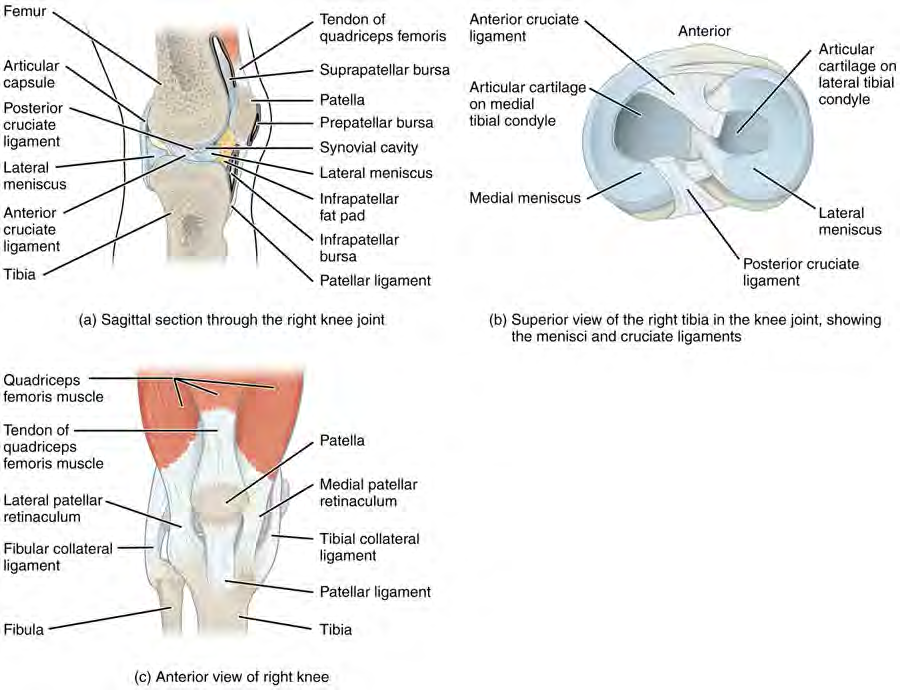
Which knee collateral ligament is attached to the medial meniscus? The tibial, or medial, collateral ligament.
What movement brings the thumb pad across the palm toward the fingertips? Opposition.
What ankle movement points the foot downward, as when rising onto the toes? Plantar flexion.
Besides dorsiflexion, what turning movement of the sole does tibialis anterior produce? Inversion of the foot.
Which joints chiefly permit the nodding movement used to signal yes? The atlanto-occipital joints.
What makes a hand muscle intrinsic rather than extrinsic? Its origin and insertion are both within the hand.
Which part of a typical vertebra is primarily responsible for bearing weight? The vertebral body.
Which large opening lies between the pubis and ischium? The obturator foramen.
Which paired vertebral processes project laterally? The transverse processes.
Besides elevating the mandible, what backward movement can the temporalis produce? Retraction of the mandible.
What ankle action is shared by gastrocnemius and soleus? Plantar flexion.
What movement raises the arm laterally away from the trunk? Abduction at the shoulder.
What happens to muscle length during a concentric contraction? The active muscle shortens.
What movement of the mandible opens the mouth? Depression.
What movement decreases the angle between the arm and forearm at the elbow? Flexion.
What is the curved superior border of the ilium called? The iliac crest.
Which two muscles are named for producing forearm pronation? Pronator teres and pronator quadratus.
What does deep mean in anatomical descriptions? Farther from the body surface.
What is the prominent longitudinal ridge on the posterior femoral shaft called? The linea aspera.
Which skeletal muscle separates the thoracic and abdominal cavities? The diaphragm.
Which bones form the distal carpal row, from lateral to medial in anatomical position? Trapezium, trapezoid, capitate, and hamate.
Which membrane lines the medullary cavity? The endosteum.
Which ribs normally have no anterior attachment to the sternum or another rib's cartilage? Ribs 11 and 12, the floating ribs.
Does a typical skeletal muscle fiber contain one nucleus or multiple nuclei? Multiple nuclei.
What movement combines flexion, extension, abduction, and adduction so a limb's distal end traces a circle? Circumduction.
Which protein inside muscle fibers binds and stores oxygen? Myoglobin.
What ankle movement brings the top of the foot toward the anterior leg? Dorsiflexion.
At which bony prominence does the distal tendon of biceps brachii attach? The radial tuberosity.
To which major tissue class does bone belong? Connective tissue.
With which bone does the patella directly articulate? The femur.
Which ridge separates the supraspinous and infraspinous fossae? The spine of the scapula.
Which bone forms the lateral malleolus at the ankle? The fibula.
What type of fibrous joint joins bones through a ligament or interosseous membrane? A syndesmosis.
Which paired bones form the bony bridge of the nose? The nasal bones.
Which bone occupies the thigh? The femur.
Which muscle organelle stores and releases calcium for contraction? The sarcoplasmic reticulum.
Through which fibrous band does tensor fasciae latae help stabilize the lateral knee? The iliotibial tract, or iliotibial band.
Which intrinsic hand muscle helps bring the thumb across the palm for opposition? Opponens pollicis.
What happens to the width of the A band as a sarcomere shortens? It remains constant because thick-filament length stays constant.
What movement at the hip is characteristic of the medial thigh compartment? Adduction of the thigh.
Which tarsal bone lies immediately anterior to the calcaneus on the lateral side? The cuboid.
Which type of synovial joint occurs at both the shoulder and hip? A ball-and-socket joint.
In the traditional origin–insertion description, which attachment is usually more stationary? The origin.
Which paired muscle groups form the pelvic diaphragm? Levator ani and coccygeus, also called ischiococcygeus.
Which skeletal division contains the limbs and their girdles? The appendicular skeleton.
Which neurotransmitter is released by a somatic motor neuron at the neuromuscular junction? Acetylcholine.
Which two kinds of motion combine during wide opening of the jaw? Hinging and forward gliding.
Which part of the scapula receives the head of the humerus? The glenoid cavity, or glenoid fossa.
What rotational action does teres minor produce at the shoulder? Lateral rotation of the arm.
What do the hand lumbricals do at the interphalangeal joints of digits 2–5? They extend those joints.
Which bone forms the cribriform plate traversed by olfactory nerve fibers? The ethmoid bone.
What attachment forms a cross-bridge during muscle contraction? A myosin head binds to actin.
Which flat abdominal muscle lies between external oblique and transversus abdominis? Internal oblique.
How many phalanges does each finger other than the thumb normally have? Three: proximal, middle, and distal.
Which bone cells resorb bone tissue? Osteoclasts.
What movement does brachioradialis produce at the elbow? Flexion of the forearm.
Which flat abdominal muscle is most superficial? External oblique.
Which connective tissue band forms the roof of the carpal tunnel? The flexor retinaculum.
Does sartorius flex or extend the knee? It flexes the knee.
What does inferior mean when comparing two body structures? Farther toward the feet or below the other structure.
Which tissue directly unites the bones at a fibrous joint? Fibrous connective tissue.
Which bone forms the back of the skull and surrounds the foramen magnum? The occipital bone.
Which space distinguishes a synovial joint from fibrous and cartilaginous joints? A fluid-containing joint cavity.
In which ossification pathway does bone form directly within mesenchymal connective tissue? Intramembranous ossification.
What do the hand lumbricals do at the metacarpophalangeal joints of digits 2–5? They flex those joints.
Which connective tissue enclosure surrounds a synovial joint cavity? The articular capsule.
Which toes are flexed by flexor digitorum longus? The four lateral toes, digits 2–5.
What is the shaft of a long bone called? The diaphysis.
Which muscle encircles the mouth and helps purse the lips? Orbicularis oris.
Which leg bone lies lateral to the tibia? The fibula.
What does superficial mean in anatomical descriptions? Closer to the body surface.
Which paired bones form the posterior part of the hard palate? The palatine bones.
Which five elongated foot bones lie between the tarsals and toe phalanges? The metatarsals.
What is the cylindrical structural unit of compact bone called? An osteon, or Haversian system.
Which three named muscles form the hamstring group? Biceps femoris, semitendinosus, and semimembranosus.
Which paired skull bones contain the structures of the middle and inner ears? The temporal bones.
What tissue replaces the cartilaginous part of a fracture callus? Trabecular bone.
How do the rotator cuff muscles stabilize the glenohumeral joint? They help hold the humeral head against the glenoid cavity during movement.
Why do muscles used for precise movements tend to have small motor units? Activating fewer fibers per neuron allows finer increments of force.
What bone shape category includes the patella? Sesamoid bone.
Which interossei abduct the fingers away from the hand's middle-finger axis? The dorsal interossei.
What type of synovial joint is the humeroulnar articulation? A hinge joint.
What does lateral mean in anatomical descriptions? Away from the body's midline.
At the base of which digit is the hypothenar eminence? The little finger.
Which major contractile protein forms the thick filaments of skeletal muscle? Myosin.
What is the cavity within the shaft of a long bone called? The medullary cavity.
How many tarsal bones are normally present in one foot? Seven.
How many sacral vertebrae normally fuse to form the sacrum? Five.
At which finger joints does flexor digitorum profundus primarily produce flexion? The distal interphalangeal joints of digits 2–5.
What mechanical role do bones perform when skeletal muscles move a joint? They act as levers that transmit muscular force.
What happens to an opening when its circular sphincter muscle contracts? The opening narrows or closes.
Does trapezius contribute to upward or downward rotation of the scapula during arm elevation? Upward rotation.
Which facial muscle compresses the cheek against the teeth? Buccinator.
What movement does gracilis produce at the hip? Adduction of the thigh.
Which connective tissue layer surrounds an entire skeletal muscle? The epimysium.
How many phalanges does the great toe normally have? Two: a proximal and a distal phalanx.
Besides elbow flexion, what forearm rotation does biceps brachii produce? Supination.
How is trabecular arrangement related to mechanical loading? Trabeculae align along lines of stress, helping support loads without filling the bone with solid tissue.
Which enzyme breaks down acetylcholine in the neuromuscular synaptic cleft? Acetylcholinesterase.
What foot movement turns the sole away from the body's midline? Eversion.
Which tissue joins the pubic bones at the pubic symphysis? Fibrocartilage.
What does superior mean when comparing two body structures? Closer to the head or above the other structure.
What movement characterizes plane synovial joints? Small sliding or gliding movements between their articular surfaces.
How do the external intercostals assist inspiration? They elevate the ribs and expand the rib cage.
What is the tough outer ring of an intervertebral disc called? The annulus fibrosus.
How many phalanges does the thumb normally have? Two: a proximal and a distal phalanx.
Which canals connect central canals with vessels toward the periosteum and endosteum? Perforating, or Volkmann, canals.
What movement carries the scapula forward around the thoracic wall? Protraction.
What is the plasma membrane of a muscle fiber called? The sarcolemma.
What remains after an epiphyseal growth plate is replaced by bone? An epiphyseal line.
Which bone forms the lower jaw? The mandible.
Which unpaired bone forms the posteroinferior part of the nasal septum? The vomer.
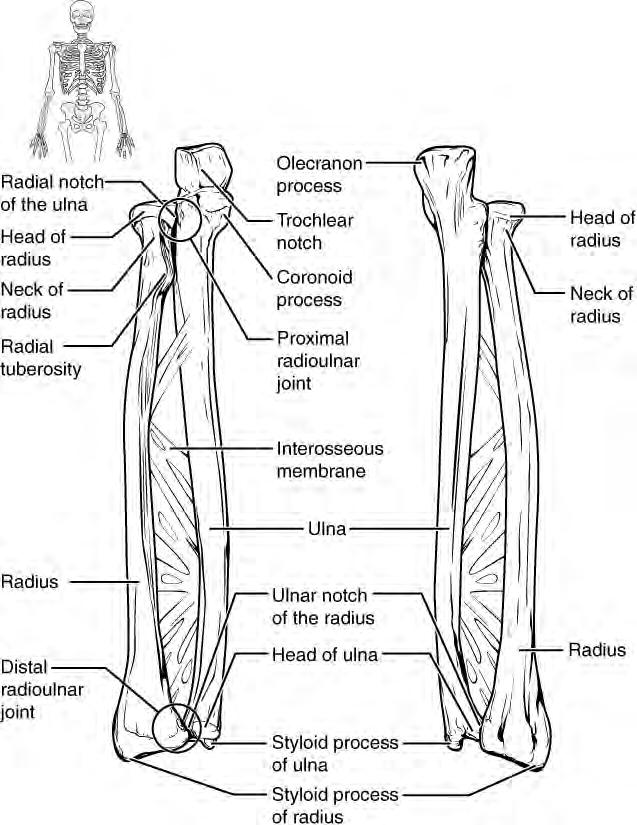
What type of synovial joint is the proximal radioulnar joint? A pivot joint.
Which hook-like scapular process projects anteriorly below the lateral clavicle? The coracoid process.
Which paired bones form the upper jaw? The maxillae.
Which crosses the knee joint: gastrocnemius or soleus? Gastrocnemius crosses the knee; soleus originates below it.
When the right sternocleidomastoid acts alone, toward which side does it turn the face? Toward the left, opposite the contracting muscle.
Which organic component helps bone resist brittleness and provides flexibility? Collagen fibers.
What shoulder movement is produced chiefly by the middle part of deltoid? Abduction of the arm.
Which pelvic prominences bear weight during sitting? The ischial tuberosities.
Which quadriceps muscle crosses the hip joint as well as the knee? Rectus femoris.
On which bone is the deltoid tuberosity located? The humerus.
What ankle movement is characteristic of most muscles in the posterior leg compartment? Plantar flexion.
Which anatomical plane separates superior and inferior portions of the body? A transverse, or horizontal, plane.
Which way do the palms face in anatomical position? They face anteriorly, toward the front.
Which thin-filament regulatory protein binds calcium to initiate skeletal muscle contraction? Troponin.
How can the nervous system increase a muscle's force by recruiting motor units? It activates additional motor units.
Which skeletal muscle fiber type is especially suited to sustained, fatigue-resistant activity? Slow oxidative fibers.
Which quadriceps muscle lies deep to rectus femoris? Vastus intermedius.
What spinal movement does rectus abdominis produce when the pelvis is stabilized? Flexion of the trunk.
What movement turns the anterior surface of the humerus or femur away from the midline? Lateral, or external, rotation.
Which bone-associated cells give rise to new osteoblasts? Osteogenic, or osteoprogenitor, cells.
At the base of which digit is the thenar eminence? The thumb.
What is the mechanical role of a callus during bone repair? It helps bridge and stabilize the fracture.
What happens during bone remodeling? Old bone is resorbed and replaced by newly formed bone.
What turning movement of the sole is shared by fibularis longus and fibularis brevis? Eversion.
Which bone occupies the arm between the shoulder and elbow? The humerus.
What is an expanded end of a long bone called? An epiphysis.
When the right splenius capitis acts alone, toward which side does it turn the head? Toward the right, the same side as the contracting muscle.
Which region forms the broad superior part of the hip bone? The ilium.
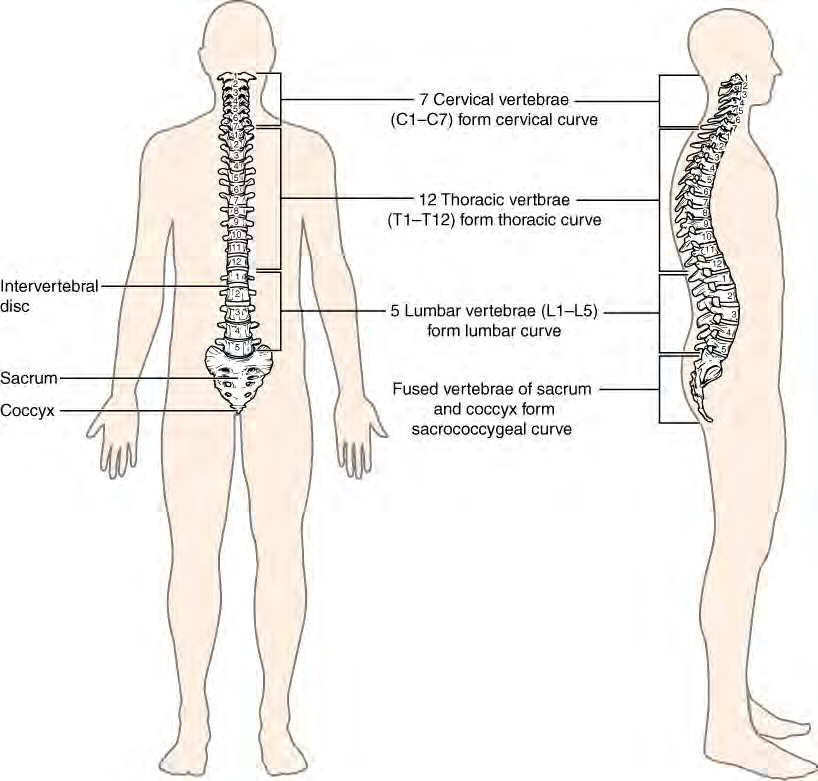
Which spinal curves develop after birth? The cervical and lumbar curves.
What is growth that increases a bone's diameter called? Appositional growth.
Which three bones fuse to form each adult hip bone? The ilium, ischium, and pubis.
What kind of articular surface is a facet? A relatively flat surface.
What rotational action does piriformis produce at the hip in the anatomical position? Lateral rotation of the thigh.
Which vertebral region is identified by foramina in its transverse processes? The cervical region.
What is the main scapular action of levator scapulae? Elevation of the scapula.
Which region of a long bone lies between its shaft and an end? The metaphysis.
Which paired facial bones are commonly called the cheekbones? The zygomatic bones.
How do ribs 8–10 connect anteriorly to the sternum? Indirectly, through the costal cartilage of the rib above.
In which muscle group's tendon is the patella embedded? The quadriceps femoris tendon.
Which skeletal division contains the skull, vertebral column, and thoracic cage? The axial skeleton.
Which suture joins the parietal bone to the squamous part of the temporal bone? The squamous suture.
Which spinal ligament helps resist excessive backward bending? The anterior longitudinal ligament.
Which rib's costal cartilage meets the sternum at the sternal angle? The second rib's costal cartilage.
What happens to the overall muscle length during an isometric contraction? It stays essentially constant while the muscle produces tension.
Which joint complex permits the atlas and head to rotate around the dens? The atlantoaxial joint complex.
Which tarsal bone lies immediately anterior to the talus? The navicular.
What movement straightens a bent knee? Extension.
What acts as the fulcrum when a skeletal muscle moves a bone as a lever? The joint about which the bone moves.
Which broad medial ankle ligament resists excessive foot eversion? The deltoid ligament.
How do the knee menisci improve the fit between the femur and tibia? They help fill the mismatch between the rounded femoral condyles and flatter tibial surfaces.
What lubricated structure surrounds a tendon where smooth sliding is needed? A tendon sheath.
What is the principal action of brachialis at the elbow? Flexion of the forearm.
What type of fibrous joint anchors a tooth root in its socket? A gomphosis.
Which type of cartilage unites bones at a synchondrosis? Hyaline cartilage.
What is the main mechanical role of a bursa? It reduces friction between adjacent moving structures, such as a tendon and bone.
Which ligament encircles and stabilizes the head of the radius? The annular ligament.
What causes an attached myosin head to detach from actin? Binding of a new ATP molecule to myosin.
How many pairs of ribs are normally present in the human thoracic cage? Twelve pairs.
Is teres major a member of the rotator cuff? No. Teres minor belongs to the cuff; teres major does not.
What structures mark the two ends of a sarcomere? Adjacent Z discs, also called Z lines.
Which flat abdominal muscle forms the deepest of the three lateral abdominal layers? Transversus abdominis.
Which scapular process articulates with the lateral end of the clavicle? The acromion.
What nourishes the avascular articular cartilage within a synovial joint? Synovial fluid.
What is a synergist in muscle action? A muscle that assists another muscle in producing a movement.
Which way does the diaphragm move when it contracts during inspiration? Inferiorly, increasing the volume of the thoracic cavity.
What is the inferior tip of the sternum called? The xiphoid process.
Which interossei adduct the fingers toward the hand's middle-finger axis? The palmar interossei.
Which large lateral prominence near the proximal femur provides muscle attachment sites? The greater trochanter.
What does distal mean when describing a limb structure? Farther from the limb's attachment to the trunk.
Besides flexion, what side-to-side wrist movement does flexor carpi ulnaris produce? Ulnar deviation, or adduction, of the hand.
Which group of five bones forms the palm? The metacarpals.
Which gluteal muscle lies deep to gluteus medius? Gluteus minimus.
What is the principal action of triceps brachii at the elbow? Extension of the forearm.
What are the concentric layers of bone matrix in an osteon called? Lamellae.
What side-bending movement can one quadratus lumborum produce? Lateral flexion of the trunk.
Does tibialis posterior dorsiflex or plantar flex the ankle? It plantar flexes the ankle.
Which bone forms the medial malleolus at the ankle? The tibia.
Which fibrocartilaginous rim deepens the shoulder socket? The glenoid labrum.
What does a fixator muscle do? It stabilizes an attachment or body part so another muscle can act effectively.
What is the broad superior part of the sternum called? The manubrium.
What is the synapse between a somatic motor neuron and a skeletal muscle fiber called? The neuromuscular junction.
What is the main hip action of gluteus medius? Abduction of the thigh.
Which leg bone carries most of the weight transmitted from the femur? The tibia.
Which joint is the upper limb girdle's only direct bony articulation with the axial skeleton? The sternoclavicular joint.
What is a foramen in a bone? An opening through the bone.
Does the distal ulna directly articulate with the carpal bones? No. An articular disc separates the ulna from the carpus.
Which bone cells build new bone matrix? Osteoblasts.
Which type of bone marrow produces blood cells? Red bone marrow.
Which skull surfaces articulate with the atlas? The occipital condyles.
Which anatomical plane separates anterior and posterior portions of the body? The frontal, or coronal, plane.
Which temporal bone depression participates in the temporomandibular joint? The mandibular fossa.
Where does a sesamoid bone develop? Within a tendon.
What are the lattice-like supports of spongy bone called? Trabeculae.
Where does growth in the length of an immature long bone occur? At its epiphyseal growth plates.
How do nutrients reach cartilage cells when the cartilage has no blood vessels? By diffusion through the cartilage matrix.
Which two bones meet at the subtalar joint? The talus and calcaneus.
What blood-derived structure forms early at a bone fracture site? A fracture hematoma, or localized blood clot.
What are the openings between adjacent vertebrae through which spinal nerves exit called? The intervertebral foramina.
Do actin and myosin filaments themselves shorten as a sarcomere shortens? No. The filaments slide past one another, increasing their overlap.
Which bone shape category includes the sternum and scapula? Flat bones.
What shape criterion makes a bone a long bone? It is longer than it is wide; its absolute size is not the criterion.
Which two carpal bones directly articulate with the distal radius? The scaphoid and lunate.
What is the major hip action of gluteus maximus? Extension of the thigh at the hip.
Which gland occupies the hypophyseal fossa of the sphenoid? The pituitary gland.
What is unusual about the hyoid bone's connection to other bones? It does not directly articulate with another bone.
What movement bends the trunk to the right or left side? Lateral flexion.
At which finger joints does flexor digitorum superficialis primarily produce flexion? The proximal interphalangeal joints of digits 2–5.
Which paired bones form much of the upper sides and roof of the skull? The parietal bones.
Which anatomical direction is toward the back of the body? Posterior, also called dorsal.
Which backward movement at the shoulder is produced by the posterior part of deltoid? Extension of the arm.
What type of cartilaginous joint is an epiphyseal growth plate? A temporary synchondrosis.
Which temporal bone prominence can be felt just behind the earlobe? The mastoid process.
What ankle movement is characteristic of the anterior leg compartment? Dorsiflexion.
Which region forms the anterior part of the hip bone? The pubis.
What does ossification mean? Formation of bone tissue.
What scapular movement occurs when the shoulders rise in a shrug? Elevation.
Which anatomical direction is toward the front of the body? Anterior, also called ventral.
What type of cartilage forms the costal cartilages? Hyaline cartilage.
Which four muscles form quadriceps femoris? Rectus femoris, vastus lateralis, vastus medialis, and vastus intermedius.
How many lumbar vertebrae are normally present? Five, designated L1–L5.
What is osteoid? Newly secreted bone matrix that has not yet mineralized.
Which bone shape category includes most carpals and tarsals? Short bones.
Which circular facial muscle closes the eyelids? Orbicularis oculi.
Where do secondary ossification centers develop in a typical long bone? In the epiphyses.
What is a bundle of skeletal muscle fibers called? A fascicle.
Which vertebral region has facets that articulate with ribs? The thoracic region.
Which skull bone contains the sella turcica? The sphenoid bone.
What is an agonist in a specified movement? A muscle that produces the movement; the principal agonist is the prime mover.
Which shoulder movement does supraspinatus assist? Abduction of the arm.
What is the spongy layer between compact bone layers in a cranial flat bone called? Diploë.
Which skeletal muscle fiber type produces rapid, forceful contractions but fatigues relatively quickly? Fast glycolytic fibers.
During which forearm movement does the radius return to a position parallel to the ulna? Supination.
Which connective tissue layer surrounds a muscle fascicle? The perimysium.
What backward movement of the arm does latissimus dorsi produce? Extension at the shoulder.
What is the gel-like central part of an intervertebral disc called? The nucleus pulposus.
How many thoracic vertebrae are normally present? Twelve, designated T1–T12.
Which distal humeral surface articulates with the trochlear notch of the ulna? The trochlea.
Which large calf muscle lies deep to gastrocnemius? Soleus.
Which ribs attach to the sternum through their own costal cartilages? Ribs 1–7, the true ribs.
Which connective tissue covering surrounds a bone's external surface except at articular surfaces? The periosteum.
Which fibrocartilaginous rim deepens the hip socket? The acetabular labrum.
Besides flexion, what side-to-side wrist movement does flexor carpi radialis produce? Radial deviation, or abduction, of the hand.
Which paired components form a typical vertebral arch? The pedicles and laminae.
How are fascicles oriented in a parallel muscle? They run approximately parallel to the muscle's long axis.
Is rotation at the knee more available when the knee is flexed or fully extended? When the knee is flexed.
What structures make up a motor unit? One motor neuron and all the skeletal muscle fibers it innervates.
In the traditional origin–insertion description, which attachment usually moves more? The insertion.
Why are lumbar vertebral bodies larger than cervical vertebral bodies? They support a greater load.
What tissue forms the medial and lateral menisci of the knee? Fibrocartilage.
What structural subtype of fibrous joint connects most skull bones? A suture.
To which bone does the calcaneal, or Achilles, tendon attach? The calcaneus.
Which structure lies between the mandibular condyle and temporal bone in the temporomandibular joint? An articular disc.
What does the cartilage covering a bone's joint surface do mechanically? It reduces friction and helps cushion contact between the bones.
In anatomical terminology, which part of the lower limb is the leg? The region between the knee and ankle.
What does medial mean in anatomical descriptions? Toward the body's midline.
Which tiny channels carry osteocyte processes between lacunae? Canaliculi.
What movement of the scapula toward the vertebral column is produced by rhomboid major and minor? Retraction of the scapula.
Through what kind of opening does a nutrient artery enter a bone? A nutrient foramen.
What mechanical functions do the foot arches provide during weight bearing? They distribute load and absorb some of the impact as the foot contacts the ground.
What action at the knee is shared by all four quadriceps muscles? Extension of the leg at the knee.
In anatomical terminology, which region lies between the elbow and wrist? The forearm, or antebrachium.
At which ulnar prominence does the triceps tendon attach? The olecranon.
Which vertebra has the dens, or odontoid process? The axis, C2.
Which bones meet at a sacroiliac joint? The sacrum and the ilium of a hip bone.
What type of synovial joint is the radiocarpal joint? A condyloid, or ellipsoid, joint.
Which forearm bone is medial in anatomical position? The ulna.
Which connective tissue layer surrounds an individual muscle fiber? The endomysium.
What is the principal hip movement produced by iliopsoas? Flexion of the thigh at the hip.
How many carpal bones are normally present in one wrist? Eight.
Which bone forms the forehead? The frontal bone.
What midline fibrous band joins the abdominal aponeuroses between the rectus abdominis muscles? The linea alba.
Which adult spinal curves are retained from the fetal curvature? The thoracic and sacrococcygeal curves.
What knee movement is shared by the hamstring muscles? Flexion of the leg at the knee.
In anatomical terminology, which part of the upper limb is the arm? The region between the shoulder and elbow.
Which tarsal bone articulates with the tibia and fibula at the ankle? The talus.
What is the anatomical name of the C1 vertebra? The atlas.
What movement turns the anterior surface of the humerus or femur toward the midline? Medial, or internal, rotation.
Which cruciate ligament becomes taut near full knee extension and helps resist hyperextension? The anterior cruciate ligament, or ACL.
Where do the blood vessels and nerves run within the center of an osteon? In its central, or Haversian, canal.
What happens to muscle length during an eccentric contraction? The active muscle lengthens while producing tension.
What canal is formed by the aligned vertebral foramina? The vertebral, or spinal, canal.
What movement brings an abducted thigh back toward the body's midline? Adduction at the hip.
Besides moving the toes, what supporting role do intrinsic foot muscles have? They help support the foot and its arches.
What movement draws the scapula posteriorly and medially toward the vertebral column? Retraction.
During which forearm movement does the radius cross over the ulna? Pronation.
What functional term describes a slightly movable joint? Amphiarthrosis.
Which part of the ulna forms the bony tip of the elbow? The olecranon.
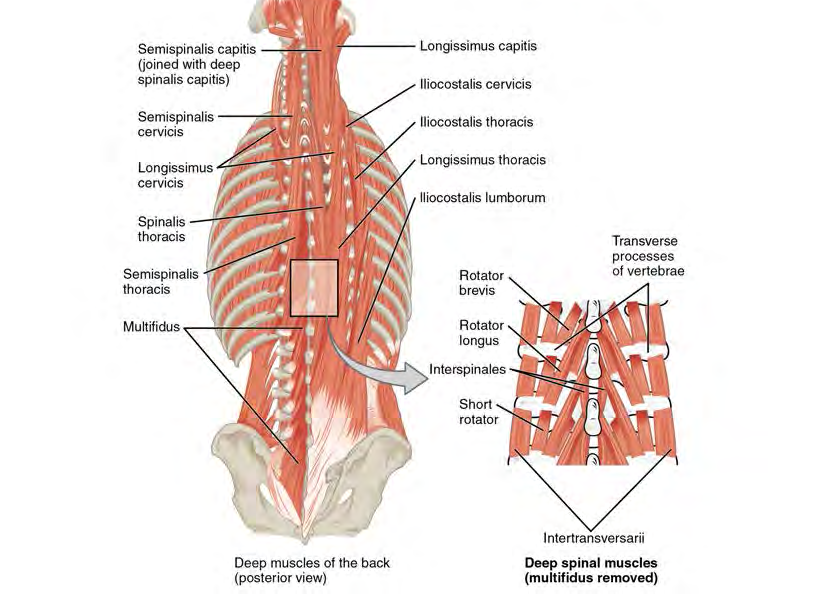
What is the main action of the erector spinae when the two sides act together? Extension of the vertebral column.
What is the hip socket that receives the femoral head called? The acetabulum.
Are the inferior nasal conchae separate bones or parts of the ethmoid? They are separate paired bones.
Which two bones provide the named origins of sternocleidomastoid? The sternum and clavicle.
In which ossification pathway does bone replace a hyaline cartilage model? Endochondral ossification.
Which bone shape category includes vertebrae? Irregular bones.
What do ligaments connect at a skeletal joint? Bone to bone, helping stabilize the joint and limit excessive movement.
Where is cytosolic calcium pumped as a skeletal muscle fiber relaxes? Back into the sarcoplasmic reticulum.
Which bones form the proximal carpal row, from lateral to medial in anatomical position? Scaphoid, lunate, triquetrum, and pisiform.
On which surface of the scapula is the subscapular fossa? The anterior surface, facing the thoracic wall.
What is the small space housing an osteocyte called? A lacuna.
Which major suture lies between the parietal bones and the occipital bone? The lambdoid suture.
At which joint do the right and left pubic bones meet anteriorly? The pubic symphysis.
What scapular movement does serratus anterior produce when reaching forward? Protraction of the scapula.
 Repeto